What Is a Fibre Leased Line? A Guide for UK Businesses
Learn how fibre leased lines work, including dedicated connectivity, symmetrical speeds, SLAs, resilience, installation and when they are worthwhile.
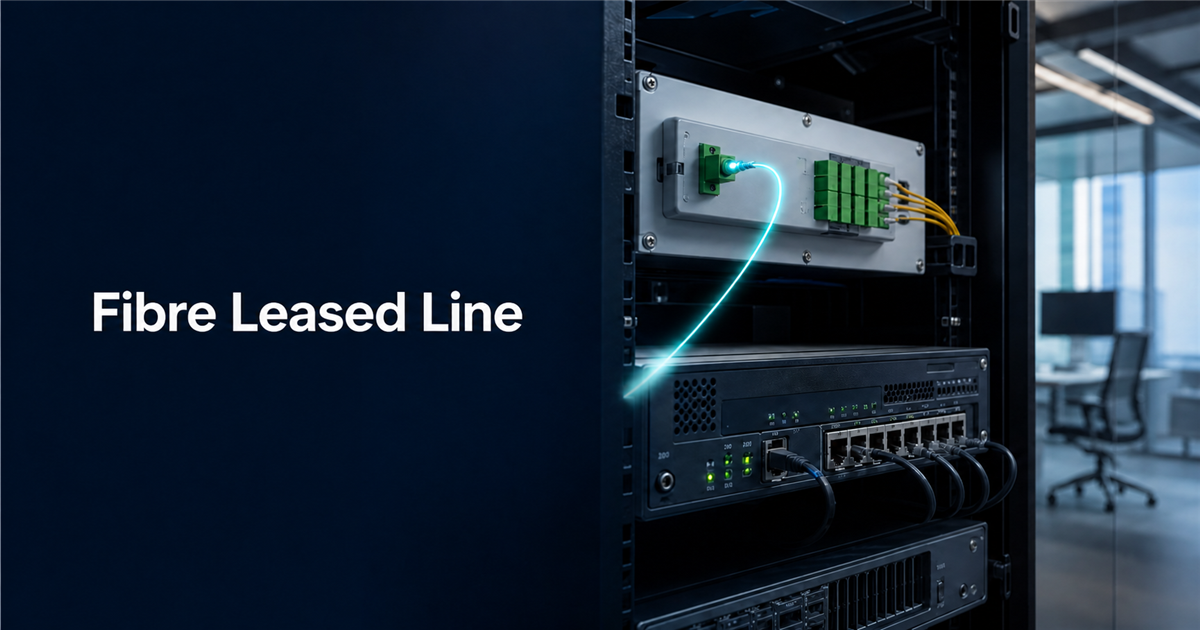
A fibre leased line is a dedicated business connectivity service that provides committed bandwidth between an organisation’s premises and a network provider.
Unlike ordinary broadband, where access infrastructure is shared, a leased line is designed to provide dedicated, predictable capacity for business use.
Leased lines are normally symmetrical, which means the upload and download speeds are the same.
They are particularly useful for organisations that depend heavily on cloud services, business VoIP, video conferencing, large data transfers or reliable connectivity between sites.
At I.T Communications, we provide Business Fibre Leased Lines with scalable bandwidth options and managed UK support.
How Does a Fibre Leased Line Work?
A fibre circuit is installed between the customer site and the provider or carrier network.
The access circuit provides dedicated capacity rather than operating in the same way as consumer or standard business broadband.
The internet service is then delivered across this dedicated access.
In practical terms, the business receives a connection designed for predictable business use rather than a best-efforts shared broadband service.
Why Is It Called a Leased Line?
The term comes from the customer effectively leasing dedicated communications capacity for the contract period.
The service is generally supplied for an agreed term with defined bandwidth, installation arrangements and service commitments.
Is a Leased Line the Same as Broadband?
No.
Both provide internet access, but the underlying service model differs.
Broadband is generally shared access.
A leased line provides dedicated committed capacity.
A modern FTTP broadband service can still be very fast, so the distinction should not be reduced to “leased line fast, broadband slow.”
The real differences include:
- Dedicated capacity
- Symmetrical bandwidth
- Service commitments
- Scalability
- Performance consistency
- Business support model
What Does Symmetrical Mean?
A symmetrical service provides the same upload and download speed.
For example:
- 100Mbps download / 100Mbps upload
- 500Mbps download / 500Mbps upload
- 1Gbps download / 1Gbps upload
This is valuable for businesses because modern internet use is increasingly two-way.
Organisations upload data when they:
- Back up to the cloud
- Send large files
- Use Microsoft Teams
- Make VoIP calls
- Host services
- Use CCTV
- Run remote desktops
- Synchronise cloud platforms
What Speeds Are Available?
Available capacity depends on the site, supplier and network architecture.
I.T Communications can provide leased-line options ranging from lower committed bandwidths through to multi-gigabit services, with current availability up to 10Gbps where supported.
Rather than copying a fixed availability table into an article, businesses should use the live Fibre Leased Line quote process because available options depend on the installation address.
What Is a Bearer?
The bearer is the maximum physical or logical capacity onto which a chosen service is delivered.
For example, a business may initially purchase a lower committed bandwidth on a larger bearer to create room for future upgrades.
The appropriate bearer should consider expected growth as well as the speed required today.
Why Do Businesses Choose Leased Lines?
Consistent Performance
Dedicated capacity can provide more predictable performance than shared broadband access.
Symmetrical Upload and Download
This supports modern cloud, voice and video workloads.
Scalability
Businesses can select appropriate bandwidth and plan for future growth.
Stronger Service Commitments
Leased-line products generally provide business-focused service levels and fault management.
Critical Cloud Access
Organisations heavily dependent on cloud platforms can reduce the performance uncertainty associated with shared access.
Voice and Video
Real-time traffic benefits from consistent network performance.
Does a Leased Line Guarantee the Internet Never Goes Down?
No.
No individual circuit should be treated as impossible to fail.
Fibre can be damaged, equipment can fail and upstream infrastructure can experience incidents.
Businesses requiring very high availability should therefore design resilience rather than relying on a single circuit regardless of its quality.
Possible options include:
- Secondary leased line
- Diverse fibre route
- Business broadband backup
- Alternative carrier
- 4G or 5G failover
- Multiple routers
What Is a Leased-Line SLA?
An SLA is a Service Level Agreement.
It defines service commitments for the connection.
Exact terms vary by carrier and product and should be reviewed before ordering.
The presence of an SLA is one reason businesses with critical connectivity often prefer leased lines over standard broadband.
How Long Does a Leased Line Take to Install?
Installation times vary significantly.
Factors can include:
- Existing fibre availability
- Distance to network infrastructure
- Site access
- Surveys
- Civil engineering
- Wayleaves
- Landlord permission
- Street works
- Carrier capacity
A simple installation may progress relatively smoothly, while a site requiring new fibre construction can take considerably longer.
Businesses should therefore start the process well before a fixed office move or service deadline.
What Is a Wayleave?
A wayleave is a legal agreement allowing network infrastructure to cross or be installed on property controlled by another party.
This commonly becomes relevant where a business occupies rented or managed premises.
A landlord or building owner may need to authorise fibre installation.
Wayleave delays can affect delivery times, so they should be identified early in the project.
Is a Site Survey Required?
Often, yes.
The provider or carrier may need to survey the installation location to confirm how the circuit can be delivered.
The survey can identify:
- Fibre route
- Entry point
- Internal cabling
- Equipment location
- Power requirements
- Civil works
- Wayleave requirements
The final delivery plan depends on the site.
What Is Excess Construction Charge?
If significant additional construction is required to deliver service, the carrier may identify extra charges.
These can arise from new ducting, fibre routes, road works or other exceptional delivery requirements.
Where applicable, such costs should be communicated before the customer commits to proceeding.
Can a Leased Line Support Hosted 3CX?
Yes.
A leased line can be an excellent foundation for a Hosted 3CX Phone System, particularly where the organisation has substantial voice traffic or high availability requirements.
Its symmetrical capacity and consistent performance also benefit other real-time services.
However, a leased line is not mandatory for every 3CX deployment.
Good-quality Business Broadband may be completely suitable for smaller sites.
Can a Leased Line Support SIP Trunks?
Yes.
Leased lines are frequently used with Business SIP Trunks and other IP voice services.
The required capacity depends on call volumes and other applications using the connection.
Is a Leased Line Good for Microsoft Teams?
Yes.
Teams voice and video benefit from stable connectivity, low packet loss and adequate symmetrical capacity.
A leased line can therefore be well suited to organisations with large numbers of simultaneous Teams users.
Do I Need a Static IP?
Business leased-line services can support static IP addressing as part of the network design.
This can be useful for:
- Firewalls
- VPNs
- Remote access
- Hosted services
- Site-to-site connectivity
- Monitoring
Larger organisations may also require provider-independent addressing or BGP routing.
What Is BGP?
BGP, or Border Gateway Protocol, is the routing protocol used between networks on the internet.
Most small organisations do not need to run BGP themselves.
However, businesses with multiple internet providers, their own autonomous system or advanced resilience requirements may use BGP to control how traffic reaches their network.
I.T Communications operates its own network and IP resources. More detail is available on our Network page.
How Much Does a Leased Line Cost?
Pricing depends on:
- Installation address
- Bandwidth
- Bearer
- Contract term
- Carrier availability
- Construction requirements
- Resilience
- Network design
For that reason, a single nationwide price would be misleading.
I.T Communications provides live postcode-based availability and pricing through our Fibre Leased Line quote tool.
Is a Leased Line Worth It for a Small Business?
Sometimes, but not automatically.
A small company running critical cloud infrastructure or handling high-value online transactions could have a stronger requirement for dedicated connectivity than a much larger organisation with modest internet dependence.
The relevant questions are:
- How important is connectivity?
- What happens during an outage?
- Is upload capacity important?
- Does performance need to be predictable?
- Are cloud and voice services critical?
- What would downtime cost?
Leased Line vs FTTP
FTTP can provide extremely fast broadband at an attractive price.
For many businesses it is an excellent choice.
A leased line becomes more compelling where the organisation needs dedicated symmetrical bandwidth, stronger service commitments or greater performance assurance.
Read our comparison: Business Broadband vs Leased Line.
How Should a Business Choose Bandwidth?
Consider current and future requirements.
Look at:
- Number of employees
- Cloud applications
- Voice calls
- Video meetings
- File transfers
- Backups
- Remote users
- Guest Wi-Fi
- CCTV
- Growth
It can be sensible to select a bearer that allows future bandwidth increases without replacing the complete access circuit, where such an option is available and commercially appropriate.
Why Use I.T Communications for a Leased Line?
I.T Communications provides voice and connectivity as part of one managed communications environment.
We can therefore consider how the leased line interacts with:
- Hosted 3CX
- SIP trunks
- Business broadband
- Telephone numbers
- Cloud applications
- Network resilience
- IP addressing
Our wider network operates across two London data centres and supports business voice, connectivity and hosted services.
Frequently Asked Questions
What Is a Fibre Leased Line?
A fibre leased line is a dedicated business connectivity circuit providing committed bandwidth between a customer site and the provider network.
Is a Leased Line Dedicated?
Yes. The access capacity is dedicated to the customer rather than delivered using the same shared-access model as ordinary broadband.
Is a Leased Line Symmetrical?
Yes, leased lines normally provide the same committed upload and download speed.
Is FTTP a Leased Line?
No. FTTP is generally a broadband access service, while a leased line is dedicated business connectivity.
Can a Leased Line Fail?
Yes. Businesses requiring high availability should consider resilient or diverse backup connectivity.
How Fast Can a Leased Line Be?
Available speeds depend on location and supplier capability. I.T Communications currently provides options up to 10Gbps where available.
How Do I Get a Price?
Leased-line pricing is location-specific. Use the live quote facility on the I.T Communications leased-line page.
Get a Fibre Leased Line Quote
I.T Communications can check live provider availability for your site and compare bandwidth, bearer and contract options.
Get a Live Fibre Leased Line Quote | Compare Business Broadband | Contact I.T Communications