Business Broadband vs Leased Line: Which Does Your Business Need?
Compare business broadband and leased lines, including contention, symmetrical speeds, resilience, SLAs, VoIP suitability and costs for UK businesses.
Compare actual proposals and service commitments
If a leased line fits your requirements, use our leased-line options and quotation service to compare bandwidth, installation and total contract cost. Read the business leased-line guide to distinguish response, restoration, exclusions and credits from a separate resilience plan.
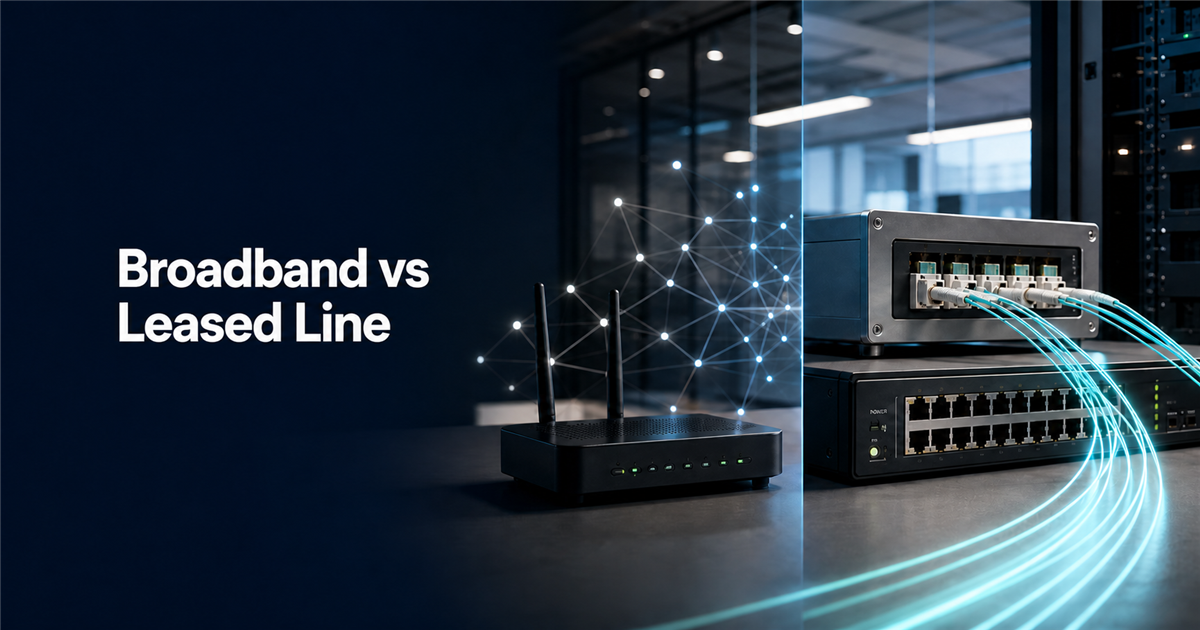
Business broadband and fibre leased lines can both provide fast internet access, but they are designed for different levels of performance, resilience and operational dependence.
For many small and medium-sized organisations, modern business broadband offers more than enough capacity for everyday cloud applications, VoIP and web access.
For organisations where internet connectivity is business-critical, a dedicated leased line can provide symmetrical bandwidth, dedicated capacity and stronger service commitments.
The best choice depends on what happens to your organisation when the connection becomes slow or unavailable.
At I.T Communications, we provide both Business Broadband and Fibre Leased Lines, so the recommendation can be based on the site’s requirements rather than forcing every organisation onto one type of service.
What Is Business Broadband?
Business broadband provides internet access using broadband technologies available at the installation address.
Depending on location and availability, this may include services such as FTTP or other business-grade access options.
Modern FTTP can provide very high download and upload speeds and may be entirely suitable for many organisations.
I.T Communications business broadband packages can include business-focused features such as managed equipment, a static IP address and UK-based support.
What Is a Fibre Leased Line?
A fibre leased line provides dedicated business connectivity rather than a shared broadband access service.
It normally offers symmetrical committed bandwidth, meaning the upload and download speeds are the same.
A leased line is designed for organisations that need more predictable performance, scalable capacity and stronger service commitments.
I.T Communications provides Fibre Leased Lines with available service speeds up to 10Gbps depending on location and supplier availability.
What Is the Biggest Difference?
The most important difference is not simply headline speed.
It is the service model.
Business broadband is generally a shared access service.
A leased line provides dedicated committed capacity to the customer.
This can make leased lines more appropriate for organisations where consistent performance matters as much as raw speed.
Is a Leased Line Faster Than Business Broadband?
Not necessarily in terms of the advertised number.
An FTTP broadband service might advertise a higher download speed than a lower-capacity leased line.
For example, a broadband connection could offer hundreds of megabits downstream while a business chooses a 100Mbps leased line.
However, the leased line provides committed symmetrical capacity rather than relying on the same shared-access model as broadband.
The better service therefore cannot be determined by comparing one headline speed figure.
What Does Symmetrical Bandwidth Mean?
A symmetrical connection provides the same upload and download capacity.
For example:
500Mbps download / 500Mbps upload
This can be valuable for businesses using:
- Cloud backups
- Hosted applications
- VoIP
- Microsoft Teams
- Video conferencing
- Large file transfers
- Cloud storage
- Remote access
- Site-to-site connectivity
Broadband services are often asymmetrical, with much higher download than upload speeds.
Whether that matters depends on how the organisation uses its connection.
What Is Contention?
Broadband access infrastructure is generally shared.
This means performance can be affected by wider network demand.
A leased line provides dedicated access capacity for the customer.
For organisations with predictable performance requirements, this difference can be more important than the maximum advertised speed.
Which Is Better for VoIP and 3CX?
Both can support business voice.
Good-quality business broadband can work very well with Hosted 3CX, SIP trunks and Microsoft Teams calling.
The correct decision depends on:
- Number of simultaneous calls
- Other internet traffic
- Upload capacity
- Latency
- Packet loss
- Resilience requirements
Businesses where telephony is highly critical may prefer the greater performance assurance and service model available with a leased line.
Which Is Better for Cloud Applications?
Again, both may be suitable.
A small office using Microsoft 365 and a handful of cloud applications may have no practical need for dedicated fibre.
A larger business running nearly every operational system in the cloud may be far more exposed to connection problems.
The more dependent the organisation is on cloud services, the stronger the case for considering dedicated connectivity and resilient backup arrangements.
Which Is Better for Microsoft Teams?
Teams uses real-time voice and video, so connection quality matters.
Modern business broadband can provide excellent Teams performance where sufficient capacity and network quality are available.
However, large organisations running many simultaneous video meetings may value the symmetrical bandwidth and predictability of a leased line.
The wider LAN and Wi-Fi environment also matters. An expensive internet circuit cannot compensate for a poorly designed local network.
What About Upload Speed?
Upload speed is one of the areas where leased lines can provide a significant advantage.
Businesses increasingly upload substantial amounts of data through:
- Cloud backup
- Video conferencing
- VoIP
- File sharing
- Hosted systems
- CCTV
- Remote access
A connection with excellent download capacity but limited upload speed can become constrained as cloud usage grows.
Symmetrical leased-line bandwidth removes that imbalance.
Are Leased Lines More Reliable?
Leased lines are generally sold with stronger business service commitments than ordinary broadband.
That can include enhanced fault handling and service-level arrangements.
However, no single physical circuit should be considered impossible to fail.
Organisations with critical uptime requirements should consider resilience in addition to the primary connection.
That could include:
- Secondary broadband
- Diverse leased lines
- Alternative carriers
- 4G or 5G failover
- Diverse physical routes
What Is an SLA?
SLA stands for Service Level Agreement.
An SLA defines service commitments around areas such as fault handling and service restoration.
The exact terms vary between services and suppliers.
Businesses should compare the actual SLA rather than assuming that every product described as “business internet” offers the same level of protection.
Which Is Better for a Small Business?
Business broadband is often the most sensible choice for a small organisation where:
- Good FTTP is available
- Internet usage is moderate
- The site has relatively few users
- Cloud and voice traffic are not excessive
- A temporary outage would be inconvenient rather than catastrophic
A leased line should not be recommended merely because it is technically superior.
The additional cost should be justified by a genuine business requirement.
When Does a Leased Line Become Worth It?
A leased line becomes more compelling where internet performance directly affects revenue or operations.
Examples include:
- Contact centres
- Large offices
- Cloud-first organisations
- Businesses with heavy upload requirements
- Companies operating critical hosted applications
- High-volume VoIP users
- Organisations with strict customer-service targets
- Multi-site networks
- Businesses moving large data sets
The question is not only “How many Mbps do we need?”
It is also “What is the cost to the business if this connection does not perform?”
Can You Use Broadband as Backup for a Leased Line?
Yes.
This is a common resilience design.
The leased line operates as the primary connection, with business broadband providing a secondary path if the primary service becomes unavailable.
Correctly configured routing equipment can detect failure and move traffic to the backup service.
The backup should be tested regularly rather than assumed to work when required.
Can You Use Two Broadband Connections Instead?
Yes, and for some organisations this can be a cost-effective resilience option.
However, two broadband services are not automatically equivalent to a leased line.
They may share infrastructure or failure points.
Businesses requiring genuine diversity should investigate the physical and carrier paths rather than simply ordering two products with different names.
What Router Do I Need?
The router should be capable of handling the connection speed and features required by the organisation.
Potential requirements include:
- Static routing
- Firewalling
- VPNs
- VLANs
- Quality of Service
- Dual-WAN failover
- Monitoring
- BGP for larger networks
I.T Communications can provide managed connectivity appropriate to the service being delivered.
Do I Need a Static IP Address?
Many business applications benefit from static addressing.
I.T Communications’ published managed business broadband packages include a static IP address.
Leased-line services can also support business IP addressing appropriate to the design.
Static addresses can be useful for:
- VPNs
- Firewall policies
- Remote access
- Hosted services
- Monitoring
- Site-to-site connectivity
What About Public IP Space and BGP?
Larger or more technically demanding organisations may require their own IP addressing and BGP routing.
This is beyond the requirements of most small-business broadband users but can be relevant to data centres, hosting providers and organisations requiring multi-provider resilience.
I.T Communications operates its own network infrastructure and IP resources, with further details available on our Network page.
Business Broadband From I.T Communications
Our Business Broadband services are designed around business requirements including connectivity, managed equipment, static addressing and UK support.
Availability and achievable performance depend on the installation address.
Fibre Leased Lines From I.T Communications
Our Fibre Leased Lines provide dedicated symmetrical business connectivity.
We can assess:
- Required bandwidth
- Bearer capacity
- Contract term
- Site availability
- Addressing
- Resilience
- Voice requirements
- Cloud usage
- Future growth
Frequently Asked Questions
Is a Leased Line Better Than Business Broadband?
Technically, a leased line provides dedicated symmetrical capacity and generally stronger service commitments. Whether it is better for a particular organisation depends on the business requirement and budget.
Is FTTP the Same as a Leased Line?
No. FTTP is generally a shared broadband access technology. A leased line provides dedicated business connectivity.
Is a Leased Line Symmetrical?
Yes, leased-line services are typically symmetrical, providing the same committed upload and download capacity.
Can Business Broadband Support VoIP?
Yes. Suitable business broadband can support VoIP, Hosted 3CX and Microsoft Teams where bandwidth, latency and resilience are appropriate.
Does a Small Business Need a Leased Line?
Not automatically. Good business broadband may be entirely suitable for smaller organisations.
What Happens If a Leased Line Fails?
Any individual circuit can fail, which is why organisations with critical uptime requirements should consider diverse backup connectivity.
Which Connection Is Right for Your Business?
The right service depends on users, applications, cloud usage, voice traffic, resilience requirements and the operational cost of losing connectivity.
I.T Communications can compare available business broadband and leased-line options for your site and recommend a service based on those requirements.
Explore Business Broadband | Get a Fibre Leased Line Quote | Contact I.T Communications