SIP Trunks vs Hosted VoIP: What Is the Difference?
Compare SIP trunks and Hosted VoIP, including PBX ownership, costs, migration, features, resilience and which option may suit your UK business.
Compare the costs and operating responsibilities
Once you have chosen a deployment approach, use our published call charges to assess eligible usage, and our cloud-hosted versus on-premise PBX comparison to identify who will operate the platform.
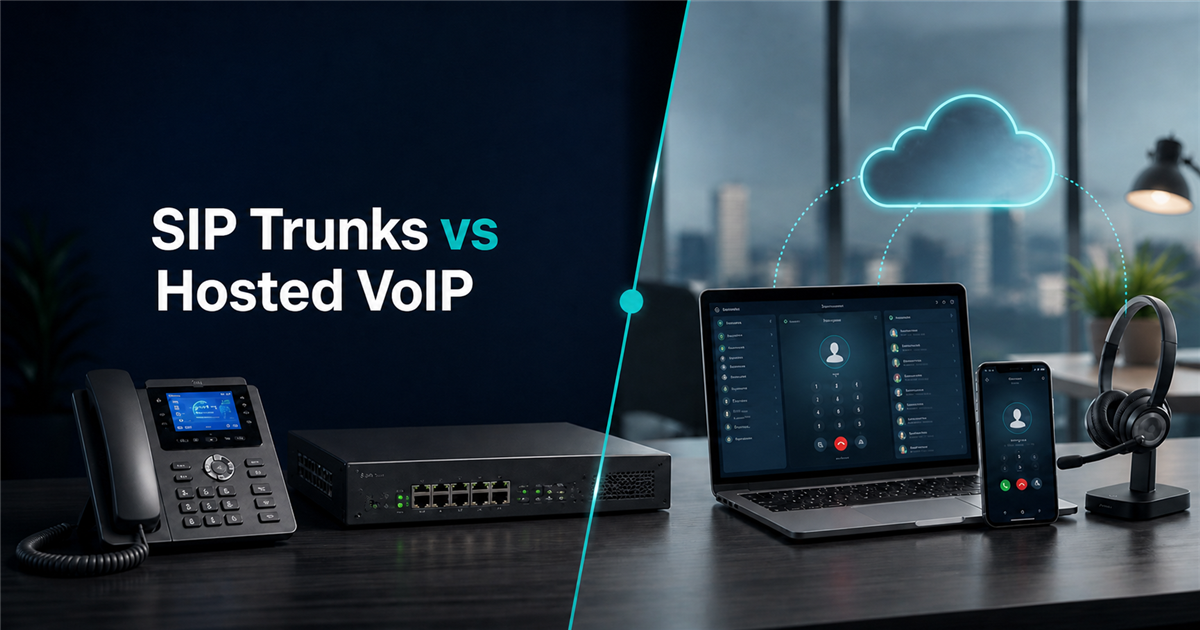
SIP trunks and Hosted VoIP both carry business calls using IP networks, but they solve different problems.
SIP trunking is normally used when a business wants to keep a compatible existing phone system and replace the traditional telephone lines connecting it to external networks.
Hosted VoIP moves the telephone-system platform itself into a hosted environment, reducing the need for the customer to operate a PBX at its own premises.
The right choice depends on the existing system, required features, internal technical resources, migration goals and future plans.
At I.T Communications, we provide both Business SIP Trunks and hosted telephone platforms including Hosted 3CX.
What Is a SIP Trunk?
A SIP trunk connects a compatible PBX to a provider’s voice network.
The customer retains the telephone-system platform while SIP replaces or modernises the external connectivity.
The PBX continues to perform functions such as:
- Extensions
- Call routing
- Queues
- Ring groups
- IVRs
- Voicemail
- Reporting
The SIP provider carries calls between that PBX and public telephone networks.
What Is Hosted VoIP?
Hosted VoIP moves the business phone-system platform into a hosted environment.
Instead of maintaining the main PBX infrastructure at the customer premises, users connect to a remotely hosted communications platform.
Depending on the selected service, users can access calling through:
- Desk phones
- Desktop applications
- Web clients
- Mobile applications
I.T Communications provides several Business VoIP options, including Hosted 3CX, SIP trunks, Microsoft Teams calling and Soft-Switch PBX.
What Is the Main Difference?
The simplest distinction is:
SIP trunking keeps the PBX and changes the lines.
Hosted VoIP changes the PBX environment as well.
This distinction is important because the two options can involve very different migration projects.
A business with a modern, compatible PBX may have little reason to replace it immediately.
Another organisation may be running an ageing system it no longer wants to maintain. In that case, moving to a hosted platform may make more sense than investing further in the existing PBX.
When Are SIP Trunks a Good Choice?
SIP trunks can be particularly suitable when:
- The existing PBX is still fit for purpose
- The organisation has invested heavily in its current system
- Existing integrations need to remain
- The business wants control of the PBX
- The immediate requirement is to modernise line connectivity
- The existing system supports suitable SIP connectivity
Moving to SIP can therefore be a relatively focused project compared with replacing the complete communications platform.
When Is Hosted VoIP a Good Choice?
Hosted VoIP may be more appropriate when:
- The existing PBX is obsolete
- The organisation wants to reduce on-site infrastructure
- Remote and hybrid working are important
- Mobile and desktop applications are required
- The business wants centralised management
- Multiple offices need one communications environment
- A modern feature set is required
- The organisation does not want to maintain PBX infrastructure itself
Hosted platforms can be particularly attractive when the telephone system is being replaced anyway.
Which Option Is Better for Remote Working?
Hosted VoIP often provides a straightforward route to remote and hybrid working because users connect directly to a centrally hosted platform.
Platforms such as Hosted 3CX provide supported desktop, web and mobile applications.
SIP trunking can also support remote users, but the experience depends heavily on the capabilities and architecture of the existing PBX.
If the existing system was designed primarily for fixed office working, simply replacing its lines with SIP will not automatically give it all the features of a modern hosted platform.
Which Is Better for Multiple Offices?
Both can support multi-site organisations.
With SIP trunks, several offices may connect to one central PBX or use multiple PBXs depending on the architecture.
With Hosted VoIP, users from different locations can often connect to one centrally managed platform.
The correct design depends on:
- Number of sites
- Existing PBXs
- WAN connectivity
- Call routing
- Numbering
- Resilience
- Management requirements
Can You Keep Existing Telephone Numbers With Both?
In many cases, yes.
Eligible UK numbers can normally be transferred to the new provider through number porting whether the target service is SIP trunking or a hosted telephone platform.
The migration should be planned carefully so that number porting and system changes happen in a controlled sequence.
I.T Communications provides Telephone Number and porting services alongside both options.
Which Option Is Cheaper?
There is no universal answer.
SIP trunking may appear less expensive when the business already owns a suitable PBX because it does not necessarily need to replace the complete system.
However, businesses should consider the ongoing cost of:
- PBX support
- Hardware maintenance
- Software licences
- Server replacement
- Electricity
- On-site resilience
- Internal administration
- Upgrades
Hosted VoIP can shift more of those responsibilities into a managed monthly service.
The useful comparison is therefore total cost of ownership, not simply the price of one SIP channel versus one hosted-user package.
What About Call Charges?
Both service types need external telephone connectivity.
Depending on the provider and package, calls may be:
- Pay as you use
- Bundled with included minutes
- Subject to an unlimited-use policy
I.T Communications publishes current SIP pricing and call-inclusive options on the live Business SIP Trunks page.
Hosted packages should similarly be compared according to what is actually included.
Which Gives More Control?
A customer-owned or customer-managed PBX with SIP trunks can provide a high level of direct control.
That can be valuable for organisations with specialist technical teams or bespoke integrations.
Hosted VoIP shifts more responsibility to the provider.
For some businesses, that is an advantage because they no longer want to maintain telephone infrastructure.
For others, retaining direct control may remain important.
The right balance depends on internal expertise and operational priorities.
What Happens If the Internet Connection Fails?
Both SIP trunks and Hosted VoIP depend on IP connectivity.
However, the effect of an outage can differ according to the architecture.
With an on-site PBX using SIP trunks, losing the site’s internet connection may prevent that PBX from reaching the provider’s SIP network.
With Hosted VoIP, users at the affected site may lose connectivity while users at other locations continue to reach the hosted platform.
In either case, resilience can be improved through options such as:
- Secondary broadband
- Leased-line diversity
- 4G or 5G failover
- Alternative call routing
- Remote-user applications
- Multiple sites
Which Is Easier to Manage?
Hosted VoIP generally places more day-to-day infrastructure responsibility with the service provider.
SIP trunking leaves the customer responsible for more of the PBX environment.
That does not make either model inherently better.
A business with an experienced IT team may prefer retaining management responsibility.
A smaller organisation may prefer a managed service with one provider responsible for the hosted PBX, SIP service and support.
What About Security?
Both options need appropriate security.
Areas to consider include:
- Strong credentials
- PBX patching
- Firewall configuration
- Access control
- Fraud prevention
- Monitoring
- Endpoint security
- Secure remote access
With an on-site PBX, the customer may carry more responsibility for maintaining the platform.
With a managed hosted service, some of that responsibility is transferred to the provider, although users and local networks still need to be managed securely.
SIP Trunks vs Hosted 3CX
Hosted 3CX is a useful example of the difference.
If a business already has a compatible PBX it wants to retain, Business SIP Trunks may be sufficient.
If the business wants to replace that PBX with a modern hosted platform, Hosted 3CX can provide the PBX, applications and call-handling environment as a managed service.
Businesses comparing 3CX costs can also read our article: How Much Does Hosted 3CX Cost in the UK?
What Internet Connection Do You Need?
Both approaches depend on suitable IP connectivity.
Important considerations include:
- Bandwidth
- Upload capacity
- Latency
- Packet loss
- Jitter
- Network congestion
- Resilience
Suitable Business Broadband can support many deployments.
Organisations needing dedicated symmetrical connectivity or stronger service commitments may consider a Fibre Leased Line.
How Do I Choose?
Start by asking what problem the organisation is trying to solve.
Keep the Existing PBX?
If yes, SIP trunks may be the more natural option.
Replace the PBX?
If yes, Hosted VoIP deserves serious consideration.
Need Better Remote Working?
A modern hosted platform may offer a simpler route.
Have Complex Existing Integrations?
Retaining the existing PBX may reduce migration complexity.
Want Less Infrastructure to Manage?
Hosted VoIP shifts more of the platform responsibility to the provider.
Need Maximum Technical Control?
A managed or self-managed PBX with SIP connectivity may provide the desired flexibility.
Why the Provider Matters
Whether you choose SIP trunks or Hosted VoIP, the provider’s network and support model remain important.
I.T Communications operates its own UK SIP network across infrastructure in two London data centres, with carrier interconnects and direct operational control.
That infrastructure supports our SIP, Hosted 3CX and wider business-voice services.
Learn more on our Network page.
Frequently Asked Questions
Is SIP Trunking the Same as Hosted VoIP?
No. SIP trunking normally connects an existing compatible PBX to a provider, while Hosted VoIP includes the hosted telephone-system platform itself.
Do I Need a PBX for SIP Trunks?
Yes, a compatible telephone-system platform is required to use a SIP trunk.
Does Hosted VoIP Need a PBX?
Hosted VoIP still uses a PBX or communications platform, but it is hosted rather than maintained as a traditional system at the customer’s premises.
Can I Keep My Number With Either Option?
Eligible numbers can generally be ported to either service.
Which Is Better for a Small Business?
It depends on the existing system and requirements. A business without a suitable PBX may find Hosted VoIP simpler, while one with a good existing system may benefit from SIP trunking.
Which Is Better for Remote Workers?
Hosted platforms often provide a straightforward remote-working experience through desktop and mobile applications, although compatible existing PBXs can also support remote users.
Need Help Choosing Between SIP and Hosted VoIP?
I.T Communications can review your existing phone system, numbers, users, locations, connectivity and future requirements before recommending whether SIP trunks, Hosted 3CX or another business-voice option is more appropriate.
Explore SIP Trunks | Explore Business VoIP | Explore Hosted 3CX | Contact I.T Communications