SIP Trunks Explained: A Guide for UK Businesses
Learn how SIP trunks work, what they replace, how many channels you need, number porting, resilience and how to choose a UK SIP provider.
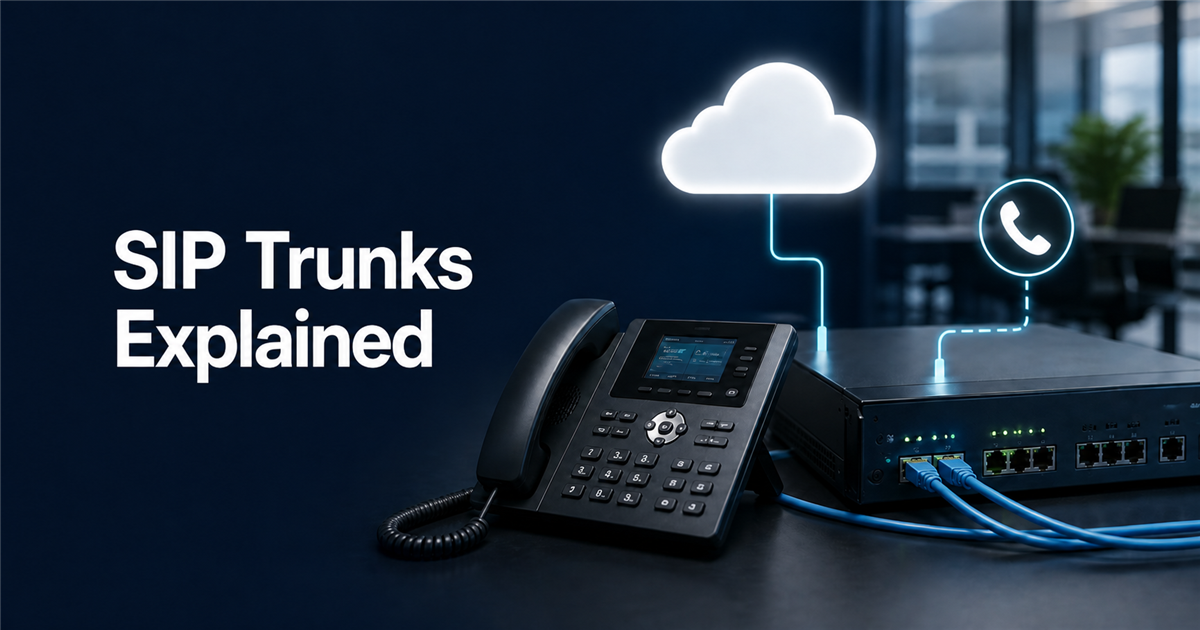
A SIP trunk connects a compatible business phone system to public telephone networks using an IP connection instead of relying on traditional telephone lines.
For businesses that already have a suitable PBX and want to modernise the connectivity behind it, SIP trunking can provide a flexible way to make and receive calls, retain existing telephone numbers and scale the number of concurrent calls as requirements change.
At I.T Communications, we provide Business SIP Trunks on our own UK SIP network, with carrier interconnects, UK telephone numbers, number porting and technical support.
What Is a SIP Trunk?
SIP stands for Session Initiation Protocol.
In business telephony, SIP is commonly used to establish, manage and end voice sessions between compatible systems.
A SIP trunk provides the connection between a business PBX and the wider telephone network.
A traditional telephone system may previously have relied on physical ISDN or analogue lines. SIP trunking moves this connectivity onto IP infrastructure.
The business can therefore retain a compatible PBX while replacing the traditional telephone lines behind it.
How Does SIP Trunking Work?
A typical SIP trunk setup contains several parts.
The Business Phone System
The customer has a compatible PBX, which may be located at the business premises or hosted elsewhere.
The PBX manages extensions, call routing, queues, ring groups and other telephone-system functions.
The SIP Trunk
The SIP trunk connects that PBX to the service provider’s voice platform.
Calls entering or leaving the business are carried through this connection.
The Provider’s Voice Network
The provider then routes calls beyond its own platform using carrier interconnects and other network arrangements.
I.T Communications operates its own UK SIP network, with voice infrastructure across two London data centres and carrier interconnects for onward call routing.
Telephone Numbers
Existing eligible business numbers can normally be ported to the SIP service.
New UK telephone numbers can also be supplied.
You can learn more through our Telephone Numbers service.
What Does a SIP Trunk Replace?
SIP trunks commonly replace traditional telephone-line connectivity behind a PBX.
Historically, businesses often connected telephone systems using technologies such as ISDN.
The move to IP-based communications means compatible PBXs can instead use SIP connectivity.
This allows organisations to retain the telephone-system functionality they need while modernising how calls reach the public telephone network.
What Is a SIP Channel?
A SIP channel represents concurrent call capacity.
One SIP channel supports one concurrent call.
For example, if a business needs to support up to 20 external calls taking place at the same time, it would normally need sufficient SIP channels to accommodate that peak demand.
The number of employees does not necessarily equal the number of channels required.
A 50-person office may rarely have more than ten people making or receiving external calls simultaneously, while a smaller sales operation could have much heavier concurrent usage.
How Many SIP Channels Does My Business Need?
The correct number depends on the busiest realistic period.
Businesses should consider:
- Number of users
- Peak concurrent calls
- Sales and customer-service activity
- Seasonal peaks
- Incoming and outgoing call patterns
- Growth plans
- Resilience requirements
The objective is to provide enough capacity for peak demand without purchasing unnecessary channels.
I.T Communications assesses current and expected call patterns before recommending an appropriate SIP configuration.
Can I Keep My Existing Telephone Numbers?
In many cases, yes.
Eligible UK geographic and non-geographic telephone numbers can normally be transferred between providers through number porting.
This means moving to SIP trunking does not automatically require changing the numbers customers already know.
I.T Communications can coordinate eligible number ports as part of the migration to our SIP service.
Can SIP Trunks Provide New Telephone Numbers?
Yes.
Businesses can obtain new numbers as well as porting existing ones.
This may be useful when:
- Opening a new office
- Launching a new department
- Establishing a regional presence
- Creating campaign numbers
- Expanding call capacity
- Replacing historic numbering arrangements
I.T Communications provides access to UK geographic, national and other business telephone-number options.
See our Telephone Numbers page for further information.
Do SIP Trunks Work With Any Phone System?
Not automatically.
The PBX needs to support suitable SIP connectivity and be configured correctly for the provider’s service.
Compatibility can depend on:
- PBX make and model
- Software version
- Licensing
- SIP implementation
- Firewall configuration
- NAT behaviour
- Network topology
- Codec support
Before migration, the existing system should be reviewed to confirm that it can operate correctly with the proposed SIP service.
What Internet Connection Do SIP Trunks Need?
SIP trunks use IP connectivity, so the quality of the underlying network matters.
A suitable connection needs sufficient bandwidth for voice alongside the organisation’s other traffic.
Important factors include:
- Upload capacity
- Download capacity
- Latency
- Jitter
- Packet loss
- Network congestion
- Router performance
- Resilience
For many organisations, suitable Business Broadband may be sufficient.
Businesses with higher capacity or service-level requirements may benefit from a dedicated Fibre Leased Line.
Are SIP Trunks Suitable for Multiple Offices?
Yes.
SIP trunking can support multi-site organisations, although the correct architecture depends on where the PBX is located and how calls are routed.
A company might operate:
- One central PBX serving several offices
- Multiple PBXs
- A hosted PBX
- Resilient voice infrastructure across sites
The design should consider connectivity, telephone numbers, failover and business continuity as well as the SIP channels themselves.
What Happens If My Internet Connection Fails?
If the PBX is located at the business premises and the connection carrying SIP traffic fails, the PBX may no longer be able to receive calls through that path.
A well-designed service can provide alternative routing options.
For example, incoming calls may be redirected to another destination when the customer system or connection cannot receive them.
Depending on requirements, businesses can also consider:
- Secondary broadband
- 4G or 5G failover
- Diverse fibre
- Alternative office routing
- Mobile destinations
- Secondary PBX infrastructure
Resilience should be planned before an outage rather than improvised during one.
What Are the Benefits of SIP Trunking?
Keep an Existing Compatible PBX
Businesses do not necessarily need to replace a phone system that still meets their requirements.
SIP can modernise the external connectivity while retaining the existing PBX.
Flexible Capacity
Concurrent call capacity can be sized according to the organisation’s requirements.
Keep Existing Numbers
Eligible telephone numbers can generally be ported to the new provider.
Geographic Flexibility
Numbers and call routing are no longer necessarily tied to a physical copper line entering one building.
Resilience Options
Calls can be designed with alternative routing and failover arrangements.
Integration With Modern Networks
SIP fits naturally into IP-based business communications environments.
SIP Trunks vs Hosted PBX
A SIP trunk and a Hosted PBX are not the same thing.
With SIP trunking, the business generally retains its compatible telephone system and changes the connectivity behind it.
With a Hosted PBX, the telephone-system platform itself is hosted as a managed service.
For example, I.T Communications provides Hosted 3CX for businesses that want the PBX platform hosted and managed.
SIP trunks may be more appropriate for organisations that already have a compatible PBX they want to keep.
Hosted VoIP may be more appropriate where the business also wants to replace or move the PBX.
How Much Do SIP Trunks Cost?
Pricing depends on the provider, number of channels, call package, telephone numbers and contract.
I.T Communications currently publishes SIP options from £4 per channel per month, with different call-inclusive options available.
Current pricing should always be checked on our live Business SIP Trunks page rather than relying on a static article.
What Should I Compare Between SIP Providers?
Do not compare only the monthly channel price.
Consider:
- Who operates the SIP platform
- Network resilience
- Carrier interconnects
- Number-porting support
- Technical support
- Call routing
- Failover options
- Call pricing
- Included minutes
- Contract terms
- Monitoring
- Network visibility
Two services described as “SIP trunks” can have very different operational models behind them.
Why Does the Provider’s Network Matter?
The voice network behind the SIP trunk is part of the service your customers depend on.
A provider operating its own network has greater direct visibility into the platform than a company simply reselling an anonymous wholesale service.
I.T Communications operates its own UK SIP network and maintains carrier interconnects for onward routing.
Our voice platform operates across infrastructure in two London data centres, giving our engineering team direct operational control over the SIP service, routing and platform beneath it.
You can learn more about our infrastructure on the I.T Communications Network page.
SIP Trunks From I.T Communications
I.T Communications provides SIP trunking for compatible business telephone systems.
Our service can combine:
- SIP channels
- UK telephone numbers
- Number porting
- Call packages
- Resilient routing
- Connectivity guidance
- Business broadband
- Fibre leased lines
- Technical support
We operate our own UK SIP network rather than simply reselling an anonymous third-party SIP platform.
Frequently Asked Questions
What Is a SIP Trunk?
A SIP trunk is an IP-based connection between a compatible business phone system and a telephone-service provider’s voice network.
How Many Calls Can One SIP Channel Handle?
One SIP channel supports one concurrent call.
Can I Keep My Existing Numbers?
Eligible UK numbers can normally be transferred to a new SIP provider through number porting.
Do SIP Trunks Need Internet Access?
They require suitable IP connectivity between the customer system and SIP platform.
Can SIP Replace ISDN?
For compatible systems, SIP trunking is a common modern replacement for legacy line connectivity such as ISDN.
Do I Need a New Phone System?
Not necessarily. If the existing PBX is compatible and still meets the business’s requirements, it may be possible to retain it and replace only the external line connectivity.
Are SIP Trunks VoIP?
Yes. SIP trunking is a form of business VoIP used to connect compatible telephone systems to external telephone networks.
Ready to Move to SIP Trunking?
I.T Communications can assess your PBX, existing telephone numbers, sites, connectivity and peak concurrent-call requirements before designing the appropriate SIP service.
Explore Business SIP Trunks | View Telephone Numbers | Contact I.T Communications
Planning your SIP service in more detail
For a practical next step, compare current SIP trunk pricing and included services, use our SIP trunk migration checklist, or prepare the evidence needed for our support procedure.