
SIP Trunk Failover Explained: Protecting Inbound and Outbound Calling
Understand what SIP trunk failover can protect, the dependencies it cannot remove and how to test inbound and outbound continuity.
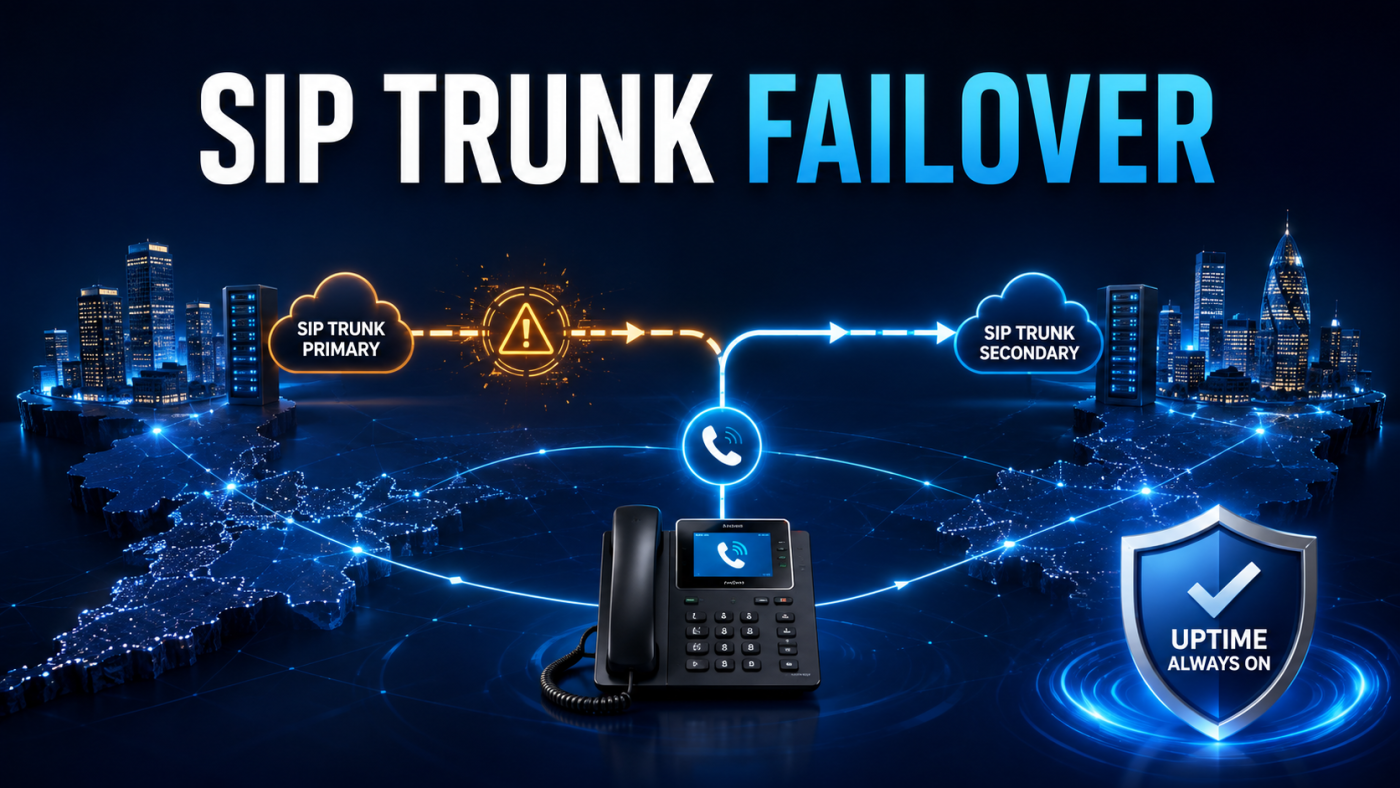
SIP trunk failover is a set of arrangements that keeps business calling available when part of the normal route fails. It is not one switch and it does not remove every dependency. Inbound numbers, outbound traffic, the PBX, access circuits, power and provider infrastructure may each need a different response.
This article focuses on continuity design. For the underlying service definition, see SIP Trunks Explained.
Inbound and outbound failover are different
Outbound calls originate from the PBX and need a working route to a carrier. A secondary trunk or provider route may be selected when the primary route is unavailable. Inbound calls begin on the public network and depend on the number provider recognising a failure and routing calls elsewhere.
A backup outbound trunk does not automatically protect inbound numbers. Likewise, rerouting inbound calls to mobiles does not restore outbound caller identification or internal call handling.
Common failure points
- Loss of the site’s internet circuit or router.
- PBX, SBC or local power failure.
- Authentication, DNS, certificate or firewall problems.
- Failure within a SIP platform, carrier route or data centre.
- Capacity exhaustion that resembles an outage.
- Incorrect number routing or an expired contingency rule.
Start with the impact of each failure. A design for one office circuit will not address an error in the number-routing platform, while data-centre resilience will not power a handset during a local outage.
Protecting site connectivity
A secondary circuit can keep the PBX or users connected when the primary access fails. It should use a suitable technology and, where justified, a genuinely diverse route. If both circuits share the same local infrastructure, one physical fault may affect them together.
The backup must have enough upload capacity and suitable latency for priority calls. Automatic router failover should preserve the required firewall, NAT and quality-of-service behaviour.
Protecting the SIP route
A provider can operate resilient signalling, media and carrier interconnects, but businesses should ask how failures are detected and what changes. The design of managed business SIP trunks should cover normal and contingency routes rather than present resilience as a label.
Where a secondary provider is used, confirm number presentation, emergency arrangements, codecs and PBX routing. The secondary path should not introduce an unsupported or untested configuration.
Inbound number rerouting
Inbound failover may route calls to another PBX, site, queue, mobile service or recorded message. Decide whether it happens automatically, after manual approval or according to a schedule. Automatic rerouting must distinguish a real outage from maintenance or a brief network interruption.
Plan capacity at the receiving destination. Sending all calls to one mobile may technically complete the route but create an unusable customer experience.
Platform and data-centre resilience
A hosted PBX can be protected through monitored infrastructure, backups and recovery arrangements. Some designs use more than one data-centre or service node. Ask how configuration and number routing are recovered, what remains active during maintenance and whether DNS or certificates create shared dependencies.
Our description of the I.T Communications network provides context for how voice and connectivity services are operated, but the continuity plan should still be matched to each customer’s sites and call flows.
Testing failover properly
Test one failure at a time and record the expected result. Simulate circuit loss, PBX unavailability and alternative inbound routing during an agreed window. Verify calls from different external networks, outbound presentation, transfers, queues and voicemail.
Measure detection and recovery time. Confirm how service returns to the primary route and whether active calls are affected. A diagram is not evidence that failover works; controlled testing is.
Operational ownership
Document alerts, escalation contacts, authority to invoke manual rerouting and the procedure for communicating with employees. Review mobile destinations and emergency messages regularly. Changes to numbers, sites and queues can make an old plan inaccurate.
Failover design examples
A small office may use one primary broadband circuit, a mobile backup and preconfigured inbound rerouting to a team of mobile applications. A larger contact operation may justify diverse fixed circuits, redundant edge equipment, resilient PBX hosting and multiple carrier paths. These are different risk responses, not good and bad versions of the same design.
For a multi-site organisation, another branch may receive calls during a local failure. That arrangement needs queue capacity, staff access and an agreed message for callers. If the second site depends on the same provider node or carrier route, the apparent diversity should be examined carefully.
How often should failover be tested?
Test after initial deployment and after material changes to routers, circuits, PBX hosting, numbers or call flows. Periodic exercises help find expired credentials, old mobile destinations and assumptions that no longer match the business. The interval should reflect the impact of failure and the rate of change.
Record the test date, scenario, result and corrective action. Avoid an uncontrolled test during a busy period; agree safeguards and a clear stop condition.
SIP failover works best as part of a broader continuity plan. Talk to I.T Communications about resilient voice routing and the specific failures your business needs to withstand.