3CX Cloud vs Local AI Transcription: Which Is Right?
A practical comparison of cloud transcription services and the standalone 3CX AI Server for businesses planning call transcription and summaries.
Release status: The standalone 3CX AI Server described for V20 Update 10 remains part of an Alpha release on 2 September 2026. Update 10 is for testing and evaluation, not production systems.
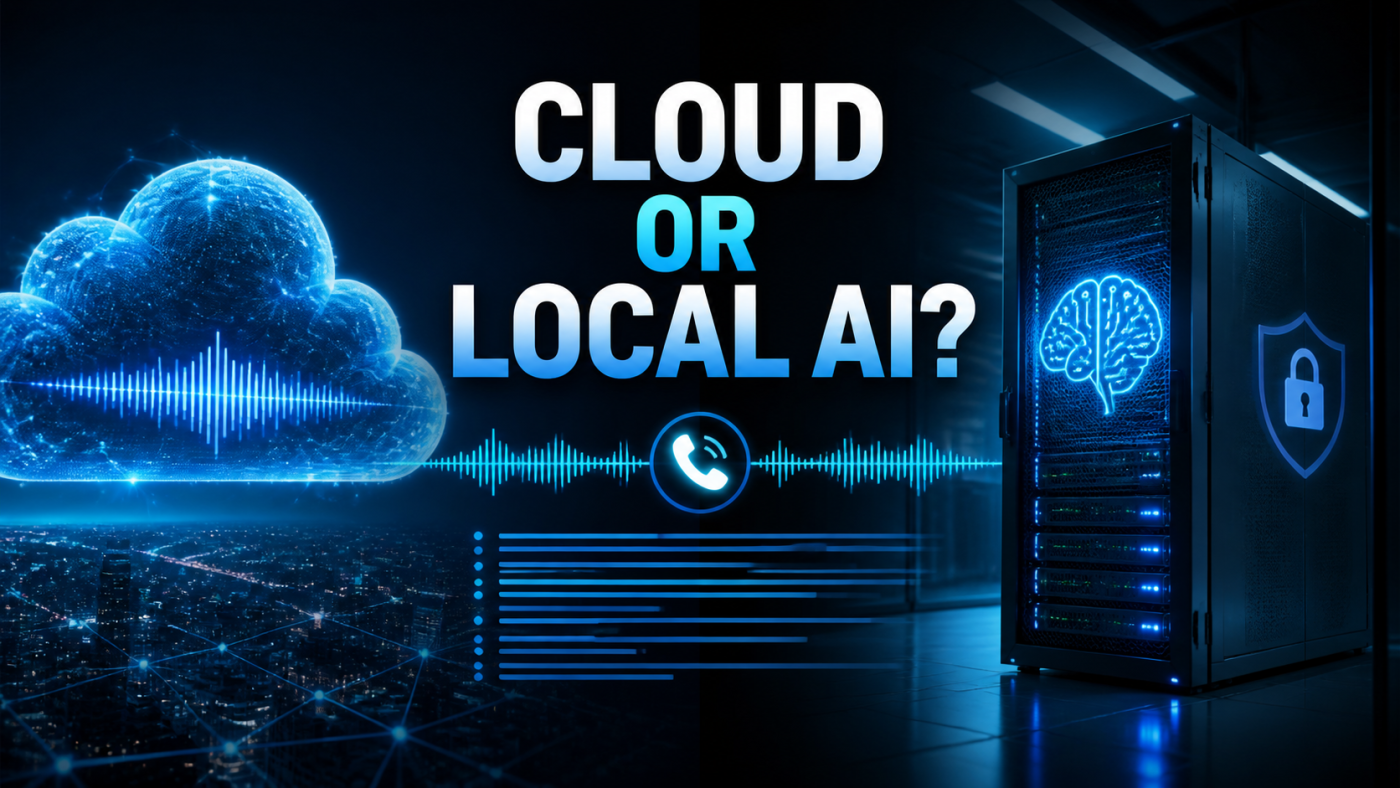
Businesses using call transcription, summaries and sentiment analysis now have a broader deployment choice: send audio to a supported cloud transcription service, or process it on infrastructure they control using the standalone 3CX AI Server. The right answer depends less on a fashionable technology choice and more on volume, privacy requirements and who will operate the platform.
3CX outlines the options in its cloud versus AI Server transcription comparison. AI transcription and summaries require the appropriate 3CX AI Edition, and recording and transcription must be enabled.
When cloud transcription makes sense
A cloud API is usually the simpler starting point. There is no dedicated AI hardware to buy, maintain or monitor, and lower or irregular usage can fit a consumption-based model. It can suit a business that wants to prove the value of transcription before committing to local infrastructure.
- Quicker initial setup.
- No local GPU or AI server to operate.
- Costs tend to follow usage.
- Provider availability, data handling and API terms must be assessed.
When a local AI Server may fit
Local processing becomes more attractive when monthly transcription volume is consistently high, predictable infrastructure costs matter, or policy requires voice data to remain within controlled infrastructure. It also transfers more responsibility to the organisation: hardware sizing, resilience, updates, monitoring and capacity planning all need an owner.
Questions to answer before choosing
- How many minutes will be transcribed in a normal and peak month?
- Which recordings are genuinely useful to transcribe?
- Where may recordings, transcripts and summaries be processed and stored?
- Who will maintain and monitor local AI infrastructure?
- What happens if the chosen service is temporarily unavailable?
- How long should recordings and generated text be retained?
Do not base the decision on headline capacity figures alone. Model the complete cost, including hardware lifecycle, electricity, support time, cloud API charges and resilience. Run a representative sample of real calls and check accuracy across accents, noise levels and call types.
Build from the business outcome
Transcription is valuable when it supports a defined workflow: finding commitments, improving quality reviews or producing structured follow-up. See our guide to 3CX AI call summaries and our 3CX AI services for help turning the feature into a controlled business process.